
Synthetic fabric is where most iron-on patch disasters happen, and almost every one of them is a heat problem. Polyester and nylon melt somewhere between 130 and 160°C. Most irons run hot enough to reach that range without even being turned up. The result is not a burnt garment but something worse: a permanent glazed, shiny, discoloured patch of the fabric that looks like the material was melted and re-frozen.
The good news is that patches can be applied to synthetics safely, as long as you respect the melting point, keep the press short, and always use a barrier cloth.
The numbers that matter
| Fabric | Melts / glazes at | Safe press | Press time |
|---|---|---|---|
| Polyester | ~150–160°C | 110–130°C (230–265°F) | 10–15s |
| Fleece (polyester) | ~150°C | 110–125°C | 10s |
| Nylon | ~140–150°C | 110–120°C (230–250°F) | 8–10s |
| Acrylic | ~120–130°C | 105–115°C | 8–10s |
| Polyamide / spandex blend | ~140°C | 110–120°C | 8–10s |
| PU / faux leather | Very low | Do not heat | Adhesive only |
How to check your iron’s actual temperature
Iron dials are notoriously inaccurate — the same setting can be 20°C off from one machine to the next. If you are working with synthetics, do this once:
- Set the iron to your guess for the low or medium-low range.
- Put a drop of water on the ironing board and hold the iron just above it for ten seconds.
- If the water does not bubble, you are below 100°C. If it flashes to steam instantly and sputters, you are at or above 140°C — too hot for most synthetics.
- Adjust down until the water just skims and slowly forms small bubbles. That is roughly 110–120°C, the safe window for polyester and nylon.
Alternatively, use our iron-on temperature calculator as the starting point and then verify on the fabric itself.
How to spot a synthetic fabric
- The burn test. Hold a small scrap in tweezers near a flame. Polyester melts into a hard bead and gives off a sweet chemical smell. Cotton burns like paper with a soft smell. Wool smells like burnt hair. Do this on a scrap, never on the garment.
- The label. A poly/cotton blend is still mostly polyester. Treat it as synthetic and use the low setting.
- The feel. Smooth, slick, slightly cool to the touch, and it does not absorb water the way cotton does — that is a polyester or nylon.
- The sheen. Fleece, performance jackets, and most gym wear are synthetic. So are most rain shells and most backpacks.
Applying a patch to polyester or fleece
- Test on a hidden area first — inside hem, under a pocket flap. Press, wait, and check for gloss or discoloration before you touch the visible area.
- Clean and dry the fabric. Synthetic fibres are hydrophobic and hold body oils. Wipe with a damp cloth, let it dry fully.
- Peel and position the patch using the adhesive backing. Check the alignment — you get one chance to move it cleanly.
- Place a thin cotton cloth over the patch. This is mandatory on synthetics. The barrier keeps the iron temperature at the fabric surface from spiking above the melting point.
- Press 10–15 seconds at the low setting. Enough to activate the adhesive, not enough to glaze the fabric.
- Cool for 30 seconds before moving.
- Repeat, pressing the seam line between letters for 5 extra seconds if you are doing a word — the gaps between letters are the weak point.
The fleece problem specifically
Fleece is polyester with a raised, brushed pile. Two issues:
- The pile flattens under pressure. A flattened patch on fleece looks permanently wrong. Press from the inside of the garment whenever the fleece is thick enough to allow it.
- Heat gets trapped in the pile. A thick fleece sweats when you wear it, and that trapped heat plus a hot adhesive is what causes patches to lift from the inside out. If the fleece is thick, use the adhesive layer only and skip the iron.
Nylon and rainwear
Nylon is the most heat-sensitive common fabric, and it has another quirk: it is very smooth and slippery, so the adhesive needs more mechanical grip than it would on cotton. Treat it like this:
- Lowest setting (110–120°C), 8–10 seconds, cotton barrier mandatory.
- Do not use steam — nylon is hydrophobic and steam spots are permanent on it.
- Expect a slightly weaker bond than on cotton. If the patch is going on a rain jacket you will wear in the rain, sew it.
When to skip the iron entirely
Use the self-adhesive layer without heat whenever:
- The garment is a technical performance fabric, a rain shell, or anything labelled do not iron.
- It is PU or faux leather.
- It is a thick fleece you care about.
- You are nervous and a test swatch has not convinced you.
Clean the surface with an alcohol wipe, peel and position, press with your thumb for 30–60 seconds, then set the garment flat under weight for several hours. Our no-iron application guide covers the details.
Common mistakes
| Mistake | Result | Fix |
|---|---|---|
| Cotton setting on polyester | Permanent shiny glaze | Drop to 110–130°C, use a barrier cloth |
| No barrier cloth | Melted or flattened pile | Always use cotton cloth on synthetics |
| Long press | Fabric glazing, patch curling | 10–15 seconds maximum |
| Using steam on nylon | Permanent water spots | Dry heat only |
| Pressing a wet garment | No bond at all | Fabric must be bone dry |
Frequently asked questions
Can you iron patches on polyester?
Yes, but only at low heat. Use 110-130°C (230-265°F) for 10-15 seconds under a thin cotton barrier cloth. At cotton-setting temperatures polyester glazes and leaves a permanent shiny, discoloured mark that does not wash out.
What temperature do you iron patches on fleece?
Use 110-125°C (230-255°F) for about 10 seconds. Fleece is usually polyester, and thick pile traps heat, so keep the press short. For thick fleece, press from the inside or use the adhesive layer only.
Will patches melt polyester?
The patch will not melt, but the polyester can. Polyester softens and glazes at roughly 150-160°C, which many irons reach even on a medium setting. The glazed fabric looks melted and the mark is permanent.
How do I iron on nylon?
Use the lowest setting, about 110-120°C (230-250°F), for only 8-10 seconds, always with a cotton barrier cloth and never with steam. Nylon is heat-sensitive and holds permanent water spots.
Is a cotton barrier cloth really necessary?
On synthetics, yes. The cloth absorbs the spike in surface temperature and keeps the fabric below its melting point, and it also stops the iron from flattening the chenille pile and dulling the gold trim. It is cheap insurance.
Can I use steam when applying patches to synthetics?
No. Steam is what causes permanent water spots on hydrophobic synthetic fibres, and on nylon and coated fabrics it can also bubble the coating. Use dry heat only.
Shop the A–Z chenille letter sets
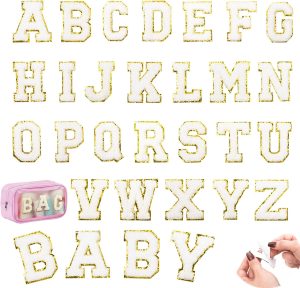
Every set is dense dimensional chenille with a metallic gold embroidered border, a strong self-adhesive backing, and an iron-on layer for permanence. Pick the size that fits your project.
Related reading
- The complete patch application guide — every fabric, every method, one page.
- Patch care and troubleshooting — what to do when a patch lifts, peels, or stains.
- Iron-on temperature calculator — pick your fabric, get the exact heat setting and press time.
- What is chenille embroidery? — how the fuzzy yarn and gold trim are made.